
American quantum physicist becomes the fifth Nobel laureate to serve as a spokesperson of the planned Discovery Center
Albert Einstein’s research into the interaction between light and atoms paved the way for Professor William D. Phillips’s Nobel Prize. Now that path leads back to Einstein’s roots in his birthplace of Ulm: Phillips is pleased to become a spokesperson of the planned Albert Einstein Discovery Center. “Modern science and technology owe much to Albert Einstein. He was a key architect of quantum mechanics and fundamentally transformed our understanding of the universe through special and general relativity. The Albert Einstein Discovery Center will bring these revolutionary ideas to life and inspire new generations to explore, understand, and further develop Einstein’s enduring legacy,” says Phillips, who shared the 1997 Nobel Prize with Steven Chu and Claude Cohen-Tannoudji for developing methods to cool and trap atoms with laser light.
Nancy Hecker-Denschlag, President of the Albert Einstein Discovery Center Ulm e.V., says enthusiastically: “With William (Bill) Phillips, we have secured the fifth Nobel laureate for our project—and with him, a scientist who cares just as deeply about communicating knowledge as he does about research itself. This commitment is also at the heart of our project.”
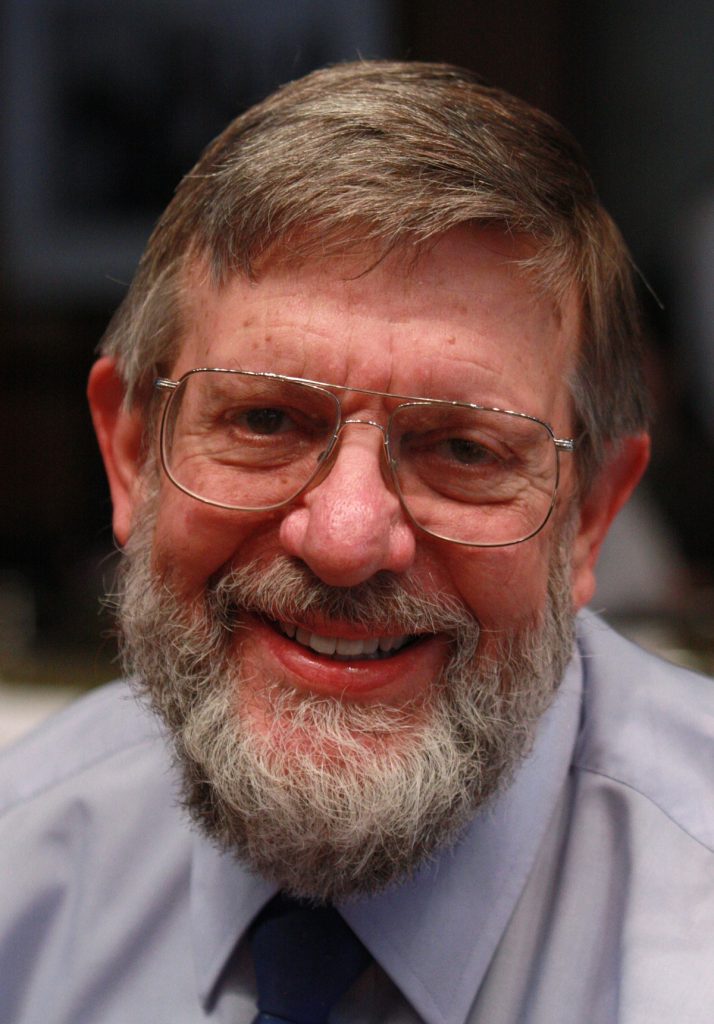
Own work, CC BY-SA 3.0
Born in 1948 in Wilkes-Barre, Pennsylvania, Phillips has conducted research at the National Institute of Standards and Technology (NIST) in Gaithersburg, Maryland, since 1978. NIST is a U.S. federal agency responsible, among other things, for official timekeeping. There, he led the Laser Cooling and Trapping Group; since 2001, he has also been a Distinguished University Professor at the University of Maryland. Beyond the scientific community, he became known for his lecture “Time, Einstein and the Coolest Stuff in the Universe,” featuring hands-on experiments for audiences with no prior scientific knowledge. He will present this lecture in Ulm on February 13, 2027.
Phillips received his Nobel Prize in 1997, eighty years after Einstein’s insight that made it possible. Together with the American physicist Steven Chu and the French physicist Claude Cohen-Tannoudji, he was honored for slowing individual atoms with laser light to such an extent that they could be trapped and studied. Einstein had already demonstrated in 1917 that light can impart momentum to an atom. “His ideas made possible numerous fields of research and technologies—from cosmology and satellite navigation to my own research on ultracold atomic gases,” Phillips emphasizes. “My research draws, among other things, on Einstein’s work on momentum exchange between light and atoms and on Bose-Einstein condensation, as well as on lasers that emerged from his concept of stimulated emission.” Today, laser-cooled atoms form the basis of atomic clocks, whose timekeeping underpins satellite navigation, and of quantum computers, including those being researched at the Ulm Science Park.
Phillips has joined the following four Nobel laureates, who also serve as spokespersons of the planned Albert Einstein Discovery Center:
- Professor Anton Zeilinger, who shared the 2022 Nobel Prize in Physics with Alain Aspect and John Clauser for experiments with entangled photons and pioneering work in quantum information science.
- Professor Reinhard Genzel, who shared one half of the 2020 Nobel Prize in Physics with the American astronomer Andrea Ghez for the discovery of the supermassive black hole known as Sagittarius A* at the center of the Milky Way.
- Professor Wolfgang Ketterle, who shared the 2001 Nobel Prize in Physics with Eric A. Cornell and Carl E. Wieman for achieving Bose-Einstein condensation in dilute gases.
- Professor Bert Sakmann, who shared the 1991 Nobel Prize in Physiology or Medicine with Erwin Neher for developing the patch-clamp technique to measure charge transport across cell membranes.

